

Great Britain KYC guide – checked September 2026
PlayOJO Verification and KYC UK: Documents, Timing and Withdrawals
 Available in GB
PlayOJO must verify core identity details before a Great Britain customer can gamble for real money. Its current guidance says the basic check covers name, address and date of birth, and that it usually tries to verify these details automatically from the information supplied at sign-up. If more evidence is needed, current PlayOJO pages list documents such as a passport, driving licence, government-issued ID card and utility bill, with a bank statement also accepted as proof of address on the document guide. PlayOJO currently says uploaded documents are usually checked in less than 12 hours and advises contacting support if there is no update after 48 hours. Those are service targets, not guaranteed completion times, because extra verification can take longer.
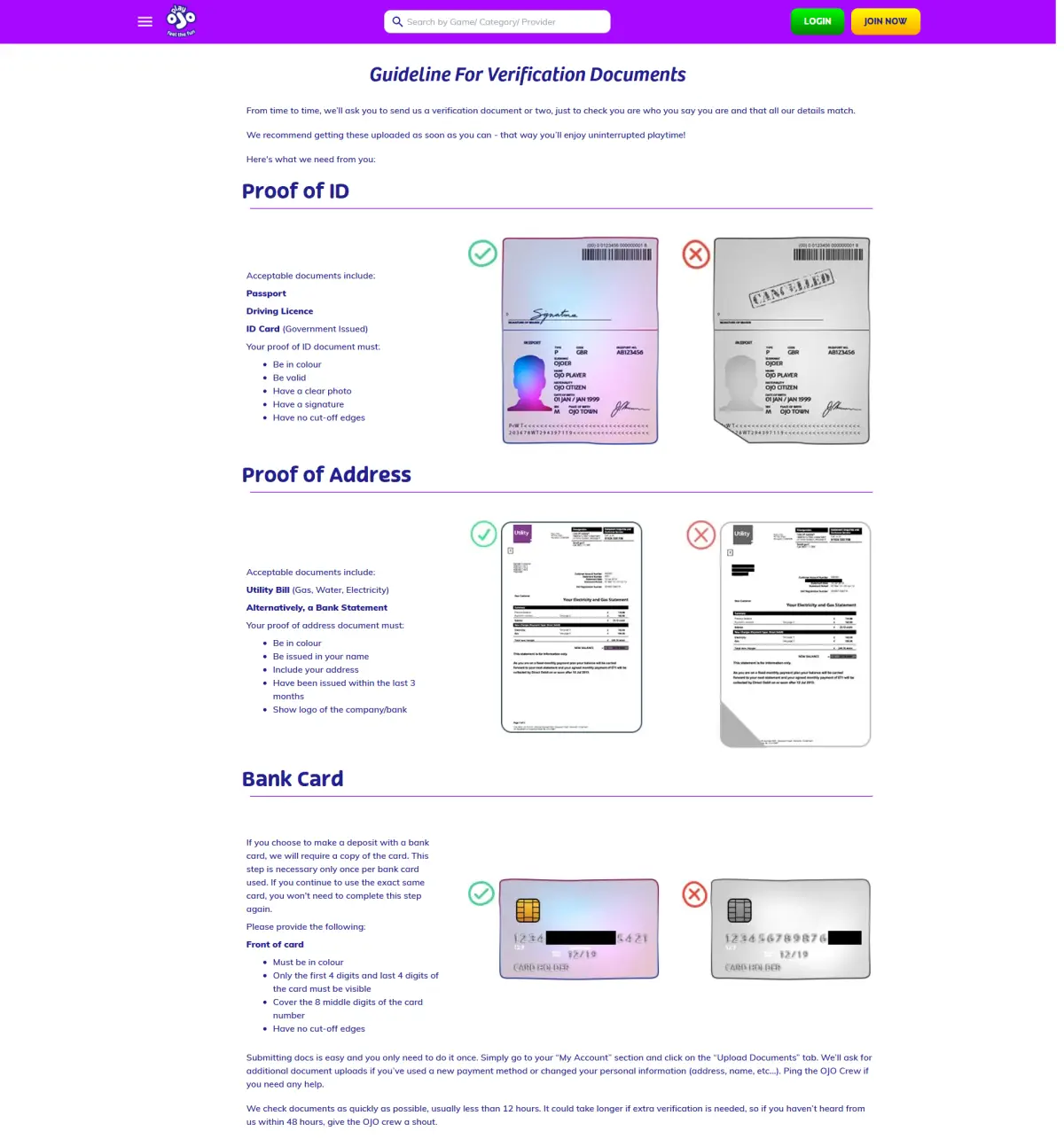
Table of Contents
- PlayOJO first checks identity, not a universal stack of documents
- Which PlayOJO verification documents can be requested
- PlayOJO currently targets under 12 hours for uploaded documents
- A practical document checklist can prevent avoidable delays
- UKGC rules stop foreseeable KYC requests being saved for withdrawal
- Why a first PlayOJO withdrawal can still involve documents
- Verification requests can expand when account details change
- KYC quality is one part of the wider trust assessment
- PlayOJO verification questions
- How PlayOJO verification can affect your first withdrawal
PlayOJO first checks identity, not a universal stack of documents
The regulatory requirement and the manual-document process are related, but they are not the same thing. The Gambling Commission requires a remote operator to establish a customer’s identity before gambling and says the information must include at least name, address and date of birth. PlayOJO’s own verification guide matches that baseline.
PlayOJO says most account verification is attempted in the background when an account is opened. It can compare the details supplied during sign-up with external records, including credit-reference and electoral-roll information. When those checks establish the required details, a manual upload is not the starting point.
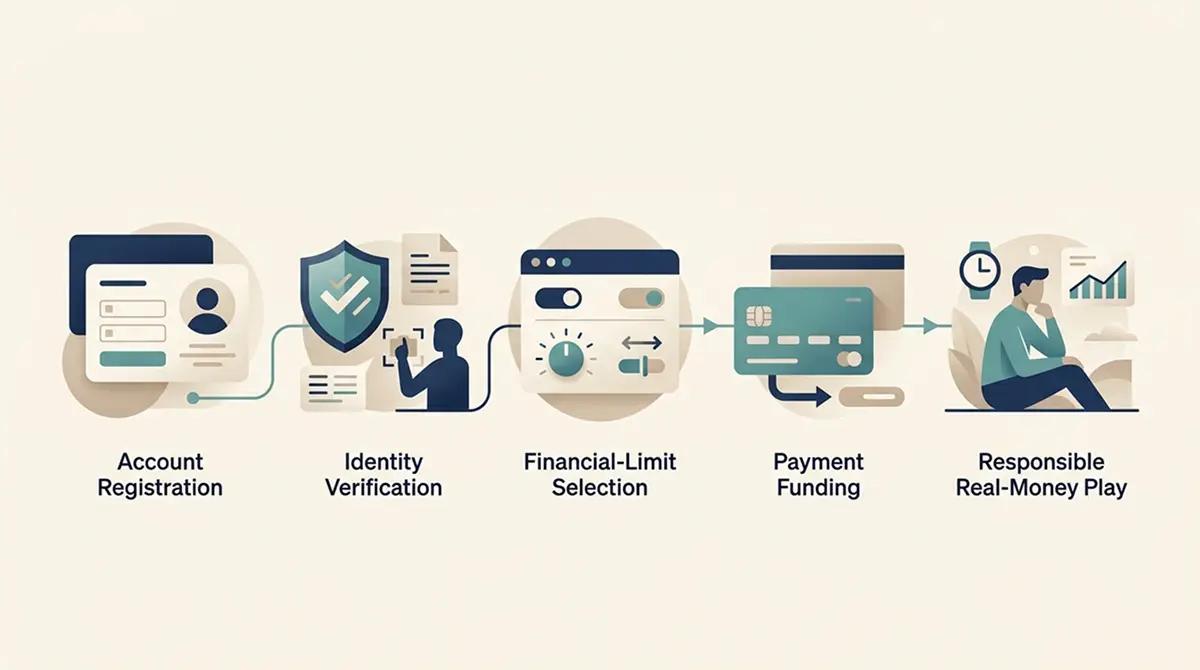
If the automatic route does not settle the check, PlayOJO can ask for documents. The practical lesson is to respond to the request shown in the account rather than upload every document type just because it appears on a general help page. The broader account sequence is covered in the PlayOJO registration guide.
There is a wording difference across PlayOJO’s current official help material. One documents subsection broadly says all players are required to upload documents, while the verification guide and another help answer say PlayOJO first tries to verify details automatically and requests copies when that does not work. For a real account, the specific verification request shown by PlayOJO is therefore more useful than treating the broad help wording as a universal sign-up checklist.
Which PlayOJO verification documents can be requested
Current PlayOJO official sources give a clear set of possible identity and address evidence. The general verification guide mentions passport, driving licence, ID card and utility bill. The dedicated document-upload page separates these into proof-of-ID and proof-of-address categories and also lists a bank statement as an address option.
| Purpose | Current PlayOJO examples | What to remember |
|---|---|---|
| Proof of identity | Passport, driving licence, government-issued ID card | The current document guide asks for a valid, clear colour copy with the document edges visible. |
| Proof of address | Utility bill or bank statement | The current guide says it should be in your name, show the address and be issued within the last three months. |
| Payment evidence | Bank-card evidence or a payment-method statement can be requested in relevant cases | Only provide what the account or support request asks for, and follow the masking instructions shown by PlayOJO. |
These are examples of acceptable evidence, not a statement that every player must upload every item. The exact request depends on what PlayOJO still needs to verify for the account.
You can see the current requirements on PlayOJO’s official verification document guide.
PlayOJO currently targets under 12 hours for uploaded documents
The current PlayOJO help centre says documents are usually checked in less than 12 hours. It also says the process can take longer if extra verification is needed and tells players to contact the OJO support team if there has been no update within 48 hours.
That wording is best read as an operational target and escalation point, not a guaranteed deadline. A straightforward document can be approved quickly, while an account that needs another check can take longer. The important distinction is that “usually under 12 hours” describes the normal document-check target, not a contractual promise that every KYC case will finish inside that window.
After an upload, PlayOJO says it sends an automated email to confirm receipt and another update after the document has been checked. If the file is rejected, the current help guidance points to common quality issues such as unclear images, expired documents or cropped edges.
The current timing is visible in the PlayOJO GB help centre.
A practical document checklist can prevent avoidable delays
Most avoidable KYC friction comes from evidence that does not match the account or cannot be read cleanly. Before uploading a requested document, compare the personal information on it with the name, date of birth and address held on the PlayOJO account.
- Use a current document when the request requires valid identity evidence.
- Upload a clear colour image and keep the document edges visible.
- For proof of address, use a document in your name showing the current address.
- PlayOJO’s current document guide asks for address evidence issued within the last three months.
- If payment evidence is requested, follow the site’s masking instructions rather than exposing more card information than required.
- Use the account upload tool specified by PlayOJO rather than sending sensitive documents to an unrelated review site.
This site does not collect identity documents, account credentials or payment evidence.
UKGC rules stop foreseeable KYC requests being saved for withdrawal
Licence Condition 17.1.1 is particularly useful when thinking about cashouts. The Gambling Commission says a withdrawal request must not result in an additional information requirement as a condition of withdrawal if the operator could reasonably have requested that information earlier.
The same condition also makes the boundary clear: an operator can still seek information at withdrawal time when another legal obligation requires it then. Anti-money-laundering, fraud or other legal checks do not disappear simply because the basic identity check was completed at registration.
What the withdrawal rule does and does not mean
It means an operator should not deliberately postpone reasonably foreseeable identity information until cashout. It does not mean every later request is prohibited, and it does not guarantee that a first withdrawal will never trigger a legitimate additional check.
The current condition is published on the Gambling Commission LCCP 17.1.1 page.
Why a first PlayOJO withdrawal can still involve documents
PlayOJO’s help material says verification documents can be requested around a first withdrawal and that the operator will email if more evidence is needed. Read that together with the UKGC rule: a routine request that could reasonably have been made earlier should not be held back simply because money is being withdrawn, but a new legal or security need can still justify another check.
This is why it helps to separate verification status from payment timing. A withdrawal can be waiting because PlayOJO is still completing a legitimate account check, or it can already be approved and waiting for the receiving payment provider. Those are different stages.
For method-specific withdrawal timing, limits and pending cashouts, use the PlayOJO withdrawals guide. It keeps cashier mechanics separate from this page’s KYC focus.
Verification requests can expand when account details change
PlayOJO’s current document guide says additional evidence can be requested when a player uses a new payment method or changes personal information such as name or address. That is a useful reminder that KYC is not always a one-off event frozen at registration.
The Gambling Commission condition also requires licensees to take reasonable steps to keep identity information accurate. If your address or other core details change, updating the account promptly reduces the chance that the account record and later evidence point in different directions.
This does not mean routine changes automatically lead to a long manual review. It means the operator can need fresh evidence when the information it must rely on has changed.
KYC quality is one part of the wider trust assessment
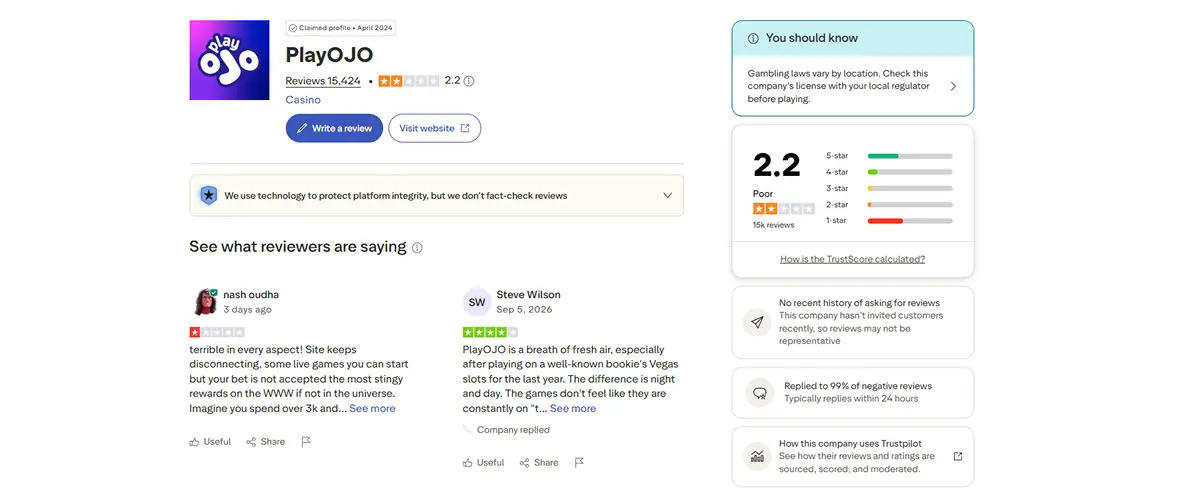
Verification can feel intrusive, but the existence of identity checks should be judged separately from the question of whether the operator is licensed and how it handles complaints. The PlayOJO trust and licence guide looks at the Great Britain regulatory record, while the planned customer reviews and complaints guide focuses on current consumer feedback and complaint themes.
That separation matters because a strict document request is not, by itself, evidence of a bad operator, and a smooth verification experience is not, by itself, proof that every other part of the service is strong. KYC is one operational checkpoint in a larger decision.
For the overall casino assessment beyond KYC, return to the main PlayOJO UK guide.
PlayOJO verification questions
What details does PlayOJO verify before gambling?
Current PlayOJO and Gambling Commission guidance identifies name, address and date of birth as core identity information that must be verified before real-money gambling in Great Britain.
Which documents can PlayOJO ask for?
Current official guidance lists examples including a passport, driving licence, government-issued ID card, utility bill and bank statement, depending on the type of evidence needed.
How long does PlayOJO verification take?
PlayOJO currently says uploaded documents are usually checked in less than 12 hours. Extra verification can take longer, and the help centre advises contacting support if there is no update after 48 hours.
Can PlayOJO ask for documents when I withdraw?
Yes, a legitimate later legal or security check can still be required. UKGC rules say an operator should not wait until withdrawal to request information it could reasonably have requested earlier.
How PlayOJO verification can affect your first withdrawal
The smoothest first withdrawal starts before the cashout request: keep account details accurate, respond to any earlier document request and upload clear evidence that matches the account. PlayOJO’s current under-12-hour document target is useful for planning, but extra checks can extend the process and should not be treated as a guaranteed deadline. The Great Britain rule also protects an important principle by preventing reasonably foreseeable identity requests from being deliberately saved for withdrawal while still allowing later checks required by law. If a cashout is pending, first establish whether the account is waiting on verification or whether an approved payment is simply moving through the withdrawal method.
Created by the ”PlayOJO Casino” editorial team.