


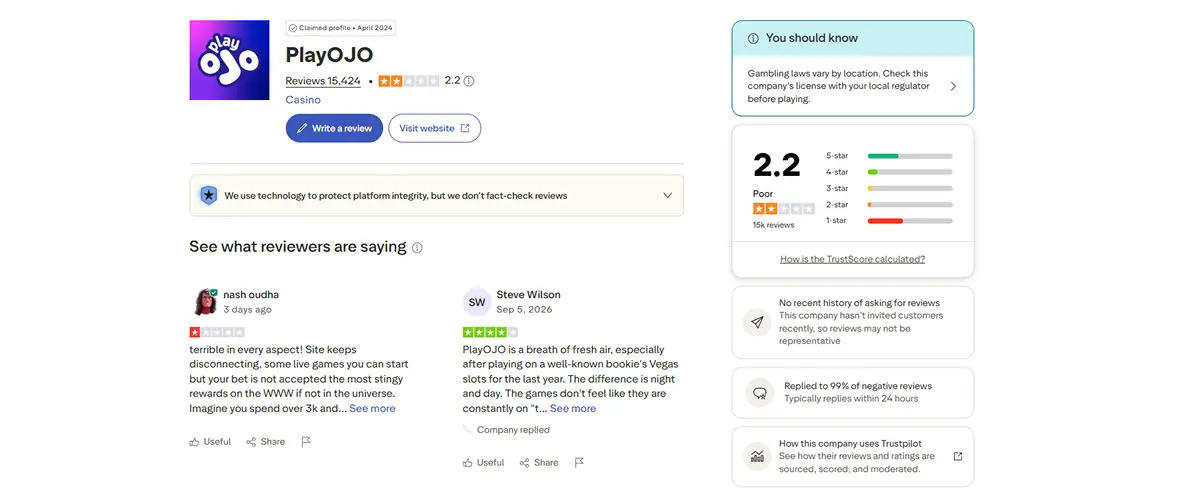
Customer sentiment snapshot – checked 11 September 2026
PlayOJO Reviews and Complaints UK: What Players Report
 Available in GB
As of 11 September 2026, PlayOJO’s UK Trustpilot profile showed a 2.2/5 TrustScore from 15,412 reviews. Trustpilot also states that the profile has been merged with one or more other profiles belonging to the company, so some reviews now shown together originally appeared elsewhere. That makes the page useful as a dated sentiment signal, but not as a clean measurement of how often any particular problem occurs. Individual reviews are user allegations or experiences, not regulator findings. The productive way to use complaints is to identify a theme, then check it against stronger evidence: licence questions against the Gambling Commission register, withdrawal claims against current payment rules, and identity-check complaints against current KYC requirements.

Table of Contents
- The Trustpilot snapshot needs context before you use it
- Withdrawal complaints should be checked against current cashout mechanics
- KYC complaints need to be separated from normal identity requirements
- Licence complaints are easy to verify independently
- Support complaints are best evaluated with a paper trail
- How the Great Britain complaints route works
- An evidence hierarchy makes complaints more useful
- What the 2.2/5 score can and cannot tell you
- How to read PlayOJO complaints without mistaking anecdotes for facts
The Trustpilot snapshot needs context before you use it
The visible rating is easy to quote and easy to overread. Trustpilot currently labels the profile “Poor” at 2.2/5 and shows 15,412 reviews. It also displays a merged-profile notice explaining that some reviews originally appeared on another profile belonging to the same company and now appear together.
That means the headline count is not a controlled sample of PlayOJO customers in Great Britain. Reviews can come from different markets, time periods and customer situations, and the people motivated to post are not necessarily representative of the wider player base. Even the platform itself describes reviews as the opinions of individual users rather than Trustpilot’s own statements.
For those reasons, this guide does not turn the 1-star or 5-star percentages into a complaint prevalence estimate. The useful question is not “what percentage of all customers have this problem?” because the review page cannot answer that. The useful question is “what issue is being alleged, and what source can verify the underlying rule?”
You can view the dated platform source at the PlayOJO Trustpilot profile, while the broader product overview remains in the main PlayOJO UK guide.
Withdrawal complaints should be checked against current cashout mechanics
Recent visible reviews include individual complaints about withdrawals and payment handling. Those accounts matter to the people who wrote them, but they do not establish that the same issue affects most customers or that a specific delay was caused by the same factor in every case.
The stronger baseline is PlayOJO’s current withdrawal guidance. The operator says most withdrawals are processed instantly, while verification or payment-provider factors can add time. Different methods can also have different minimums, transaction limits and delivery behaviour. That is why a review saying “my withdrawal was delayed” is not enough to identify whether the cause was operator processing, a KYC check, a payment-provider step or something account-specific.
A useful check is to record the requested withdrawal time, method, status messages and any support correspondence, then compare those details with the current withdrawal timing and cashout guide. If the complaint is about which methods are supported or a deposit/withdrawal route, use the broader payments guide.
KYC complaints need to be separated from normal identity requirements
Verification can feel intrusive, so it is unsurprising that identity checks appear in gambling complaints generally. In Great Britain, however, identity verification is not optional operator theatre. Remote licensees must establish identity before permitting gambling, including at least name, address and date of birth.
The Gambling Commission also says an operator should not wait until withdrawal to demand information it could reasonably have requested earlier, while preserving later checks required by other legal obligations. That distinction is important when reading a review. “I was asked for ID” is not, by itself, evidence of misconduct. A more useful question is whether the timing and nature of the request fit the applicable verification rules and the operator’s published process.
PlayOJO says it normally attempts automatic checks first and can request documents when more evidence is needed. The current document examples and timing guidance are covered in the KYC and verification guide.
Licence complaints are easy to verify independently
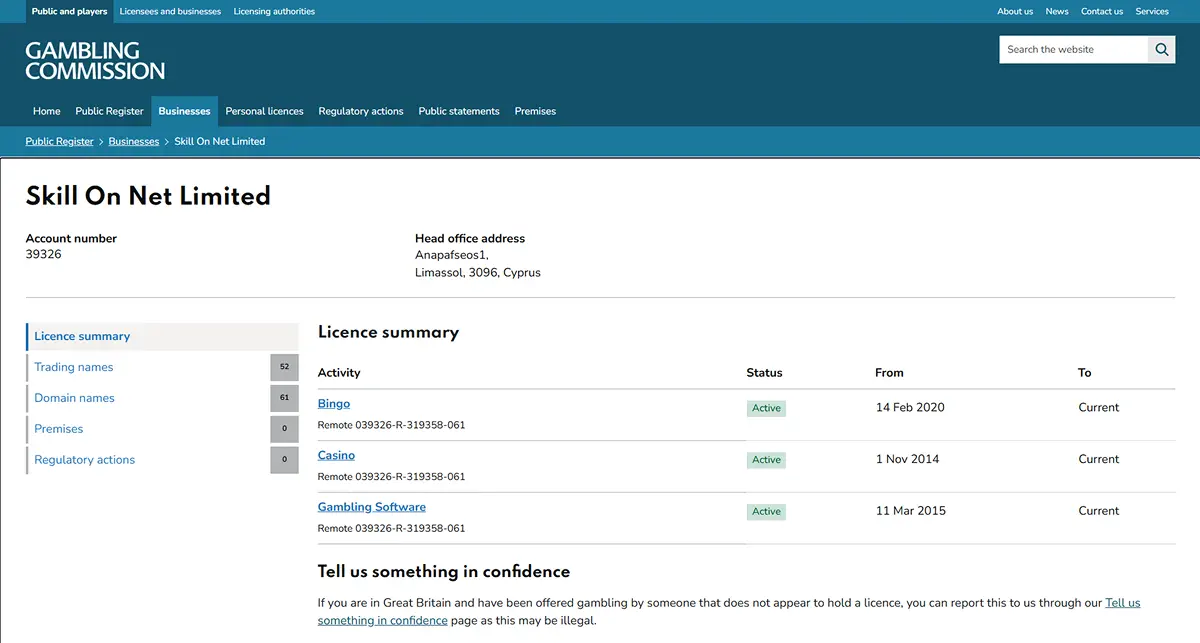
If a review questions whether PlayOJO is licensed, there is no need to choose between the reviewer and the casino. The Gambling Commission register provides a direct answer. It currently lists PlayOJO as an active trading name of Skill On Net Limited, account 39326, with the relevant remote casino and bingo licence active and current for Great Britain.
That fact should not be expanded into a claim that every customer dispute is invalid. It simply settles the licensing question with a primary source. The operator relationship, Great Britain scope and Northern Ireland distinction are explained in the PlayOJO UKGC licence and trust guide.
Support complaints are best evaluated with a paper trail
PlayOJO currently provides support through logged-in live chat and a published support email address. A review saying support was slow, helpful, confusing or excellent is inherently experiential. Two customers can have different outcomes without either account becoming a universal measure of service.
If you need to raise an issue, keep the interaction factual. Save dates, transaction IDs where relevant, copies of status messages, the question you asked and the answer you received. A concise chronology is more useful in a formal complaint than a general statement that support was “bad” or “good”.
That documentation also makes it easier to distinguish a service complaint from a gambling transaction dispute, an identity-check issue or a technical problem. The category matters because the evidence needed to resolve each one is different.
How the Great Britain complaints route works
The Gambling Commission does not normally decide individual complaints about gambling transactions or customer service. Its current guidance says the customer should first complain directly to the gambling business and follow that operator’s complaints procedure.
The licensed business has up to eight weeks to resolve the complaint process. If the customer is not satisfied, or the business reaches a final or deadlock position sooner, the dispute can be eligible for escalation to an approved Alternative Dispute Resolution provider. The ADR service is independent and free to the customer for eligible disputes.
This process is more useful than posting a second review when the goal is an actual case decision. Reviews can warn other consumers that an issue was frustrating; the formal complaint and ADR route is designed to examine evidence from both sides.
A review and a complaint are not the same thing
A public review expresses a customer’s view. A formal complaint gives the operator a defined issue to investigate, and ADR can provide independent dispute resolution after the internal process has been exhausted or the applicable time limit is reached.
The current process is set out in the Gambling Commission complaints guide.
An evidence hierarchy makes complaints more useful
| Claim you see | Best source to check next | What the review can still tell you |
|---|---|---|
| “PlayOJO is not licensed” | Gambling Commission public register | That licence confusion exists for at least that reviewer |
| “My withdrawal took too long” | Current withdrawal rules, account status and payment-provider information | The individual’s timing and support experience |
| “They asked me for documents” | Current KYC guidance and Gambling Commission identity condition | How the request felt or how clearly it was explained |
| “Support was unhelpful” | Saved chat/email trail and formal complaint response | The reviewer’s service experience |
| “The casino is great” | Product pages for the specific feature praised | Positive sentiment, not proof that every feature suits every player |
The hierarchy is deliberately boring: primary evidence for factual questions, platform reviews for sentiment. That separation prevents both positive and negative anecdotes from becoming facts they cannot support.
What the 2.2/5 score can and cannot tell you
The current 2.2/5 TrustScore tells you that PlayOJO has a weak aggregate rating on that platform at this point in time. It is reasonable to treat that as a reputation warning signal and to read recent reviews before deciding whether the service fits your expectations.
It cannot tell you the probability that you personally will have a withdrawal delay, KYC issue or support dispute. The profile-merge notice, cross-market participation, self-selection of reviewers and lack of a controlled customer denominator all limit that interpretation. Nor can the score override a regulator record or prove a breach of gambling rules.
The most balanced approach is to use the review score as a prompt for more specific checks. If a recurring theme matters to you, verify the relevant mechanics before depositing and keep records if you later need to raise a formal complaint.
How to read PlayOJO complaints without mistaking anecdotes for facts
Read customer reviews for signals, not verdicts. The dated Trustpilot snapshot shows clearly negative aggregate sentiment, and that is worth knowing, but each individual allegation still needs to be separated from verified licence, withdrawal and KYC facts.
When a complaint describes something that can be checked, move up the evidence ladder: regulator register for licensing, official guidance for payment and verification mechanics, then the formal complaint process if the issue concerns your own account. That approach gives reviews a useful role without asking them to prove more than they can.
If your main question is whether the operator itself is verifiably licensed in Great Britain, use the trust and licence guide rather than the star rating.
Prepared by the PlayOJO Casino editorial staff.